
The Judgement of Paris
How the Spiritual Manipulation of One Man’s Desire
Ended Up Burning a Nation
Before we ever hear about the burning towers of Troy or the echo of Achilles’ wrath, there’s a quieter doorway into the tragedy… the wedding of Peleus and Thetis.
A lavish, celestial banquet where mortals and gods mingled like it was the most natural thing in the world… because it is. Because in those days royalty didn’t just rule beside the “divine”… they dined with them.
They were the fragile bridge between heaven and earth.
But at this shimmering, sacred, and dripping in immortal politics celebration, one goddess decided to spice up the party.
Eris, the goddess of discord, walked in with a single golden apple and a wicked little intention: tempt Paris, twist his judgment, and ignite a chain of choices that would someday level a kingdom.
The fall of Troy didn’t begin with a war.
It began with one dangerous dare.

The Lost Poem of “The Dare”
The Cypria once recounted everything leading up to the Trojan War. Though the original epic has been lost to time, its story survives through Proclus’ summary and later Greek writers. The wedding and Paris’s judgment do not live in one single surviving book… they live within the mythic ecosystem surrounding the Trojan War.
And the story unfolds like this:
Eris was furious.
Every god and goddess had been invited to the wedding of Peleus and Thetis… except her.
But you don’t ignore disorder and expect peace to remain intact.
So Eris did what she does best. She calculated.
With deliberate calm, she cast it into the center of the banquet, where gods and mortals alike could see it gleam beneath the torchlight.
In her hand, she carried a golden apple, luminous and impossible to ignore.

Inscribed upon its surface were the words:
“For the fairest goddess of them all.”
It sounded like a compliment.
It was a provocation.
Eris intended to awaken rivalry.
And nothing stirs pride faster than the suggestion that only one can be supreme.
Immediately, three goddesses claimed it:
Hera, queen of the heavens, authority woven into her very presence.
Athena, goddess of wisdom and war, sharp-minded and strategically lethal.
Aphrodite, goddess of love and beauty, radiant and dangerously persuasive.
Eris didn’t need to say another word. She had channeled the one force more explosive than war… competition between prideful immortals.
Zeus, wisely unwilling to choose between three divine egos, refused to judge. Instead, he delegated the decision to a mortal.
Paris of Troy. A young human prince.
Untrained in the art of resisting divine persuasion.
And that is where the manipulation began.

The Divine Bribes: Power, Wisdom… or Desire
Each goddess privately approaches Paris.
Hera offers dominion over Europe and Asia. Rulership over the greatest known lands of the ancient world.
Athena promises unmatched wisdom and victory in every battle.
Aphrodite offers something softer, sweeter, and far more destabilizing:
Helen of Sparta… the most beautiful woman on earth.
But Helen is married.
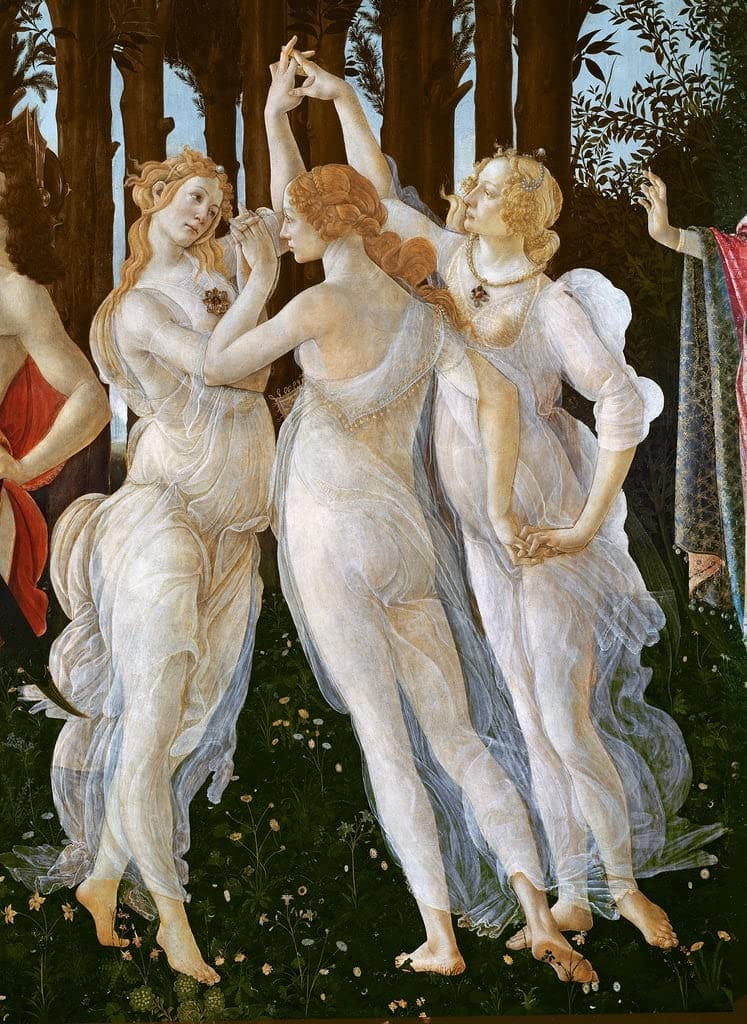
Paris does not choose sovereignty.
He does not choose strategy.
He chose desire. He wanted the most beautiful mortal woman for himself, despite the consequences.
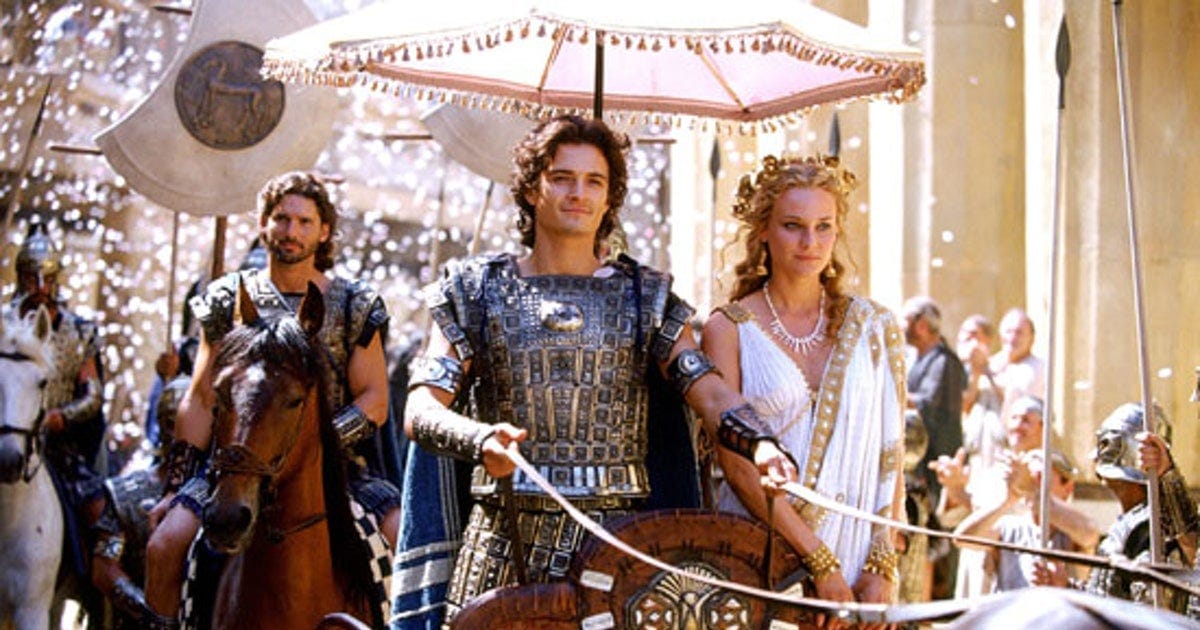
Divine Manipulation or Human Weakness?
The Greeks understood something profound: the gods do not force, they tempt.
Aphrodite did not drag Paris to ruin. She exposed the weakness already living in him.
The myth is not about celestial cruelty.
It is about human susceptibility.
Paris crowned beauty over responsibility.
Pleasure over discernment.
Impulse over foresight.
The gods in Greek mythology often behave like amplified human egos: jealous, emotional, reactive. Their power is theatrical. Conditional. Negotiable.
And here lies the spiritual warning:
False gods only have the authority we surrender to them.
Paris was not conquered.
He consented.

Life Is Art Curation: The Judgment on Canvas
What fascinates me most is how artists across centuries became obsessed with this exact moment… the pause before destruction.
The choice. The seduction. The tension.
Let’s curate three of the most iconic depictions.
1. Peter Paul Rubens – The Judgment of Paris (1630s)
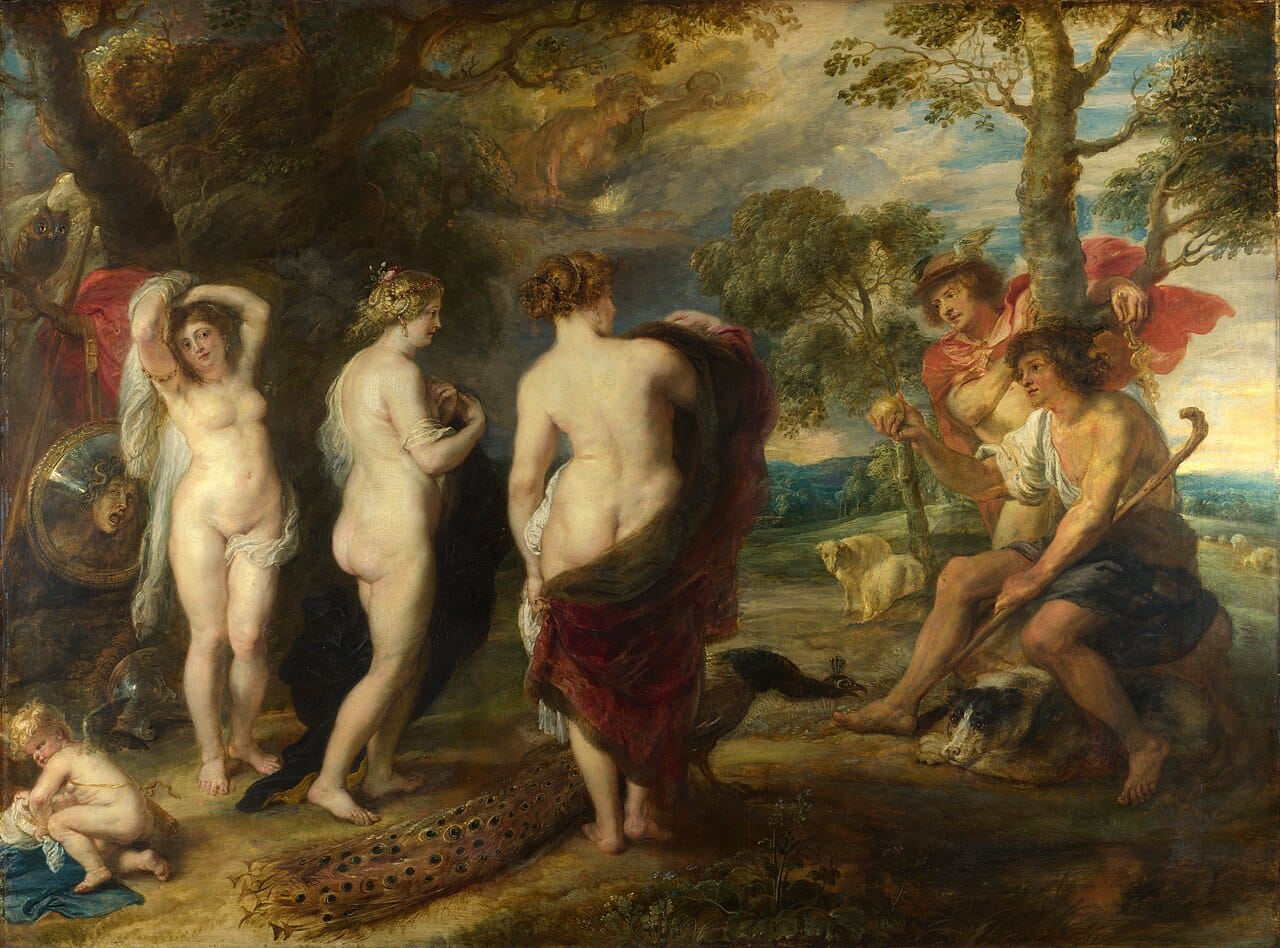
Rubens paints abundance. Flesh. Opulence. Sensuality.
The goddesses are luminous, powerful, unapologetically physical. Paris appears almost overwhelmed. Smaller in presence than the divine bodies before him.
Notice something subtle: The scene feels indulgent. Excessive. Heavy with desire.
Rubens doesn’t paint moral clarity. He paints temptation as irresistible.
In his version, Paris looks less like a ruler and more like a spectator hypnotized by spectacle.
Manipulation here is visual.
Overwhelm the senses and judgment dissolves.
2. Sandro Botticelli – The Judgment of Paris (1485–1488)

Botticelli’s interpretation is ethereal, almost delicate.
The goddesses appear graceful, composed. Paris looks thoughtful, contemplative rather than lustful.
This version emphasizes choice rather than chaos.
Yet the manipulation is still there… it is simply more refined.
The Renaissance loved harmony, but underneath the symmetry is the same fatal offering: Beauty presented as destiny.
Botticelli captures the illusion that desire can look divine.
3. Jacques-Louis David – The Judgment of Paris (c. 1788)
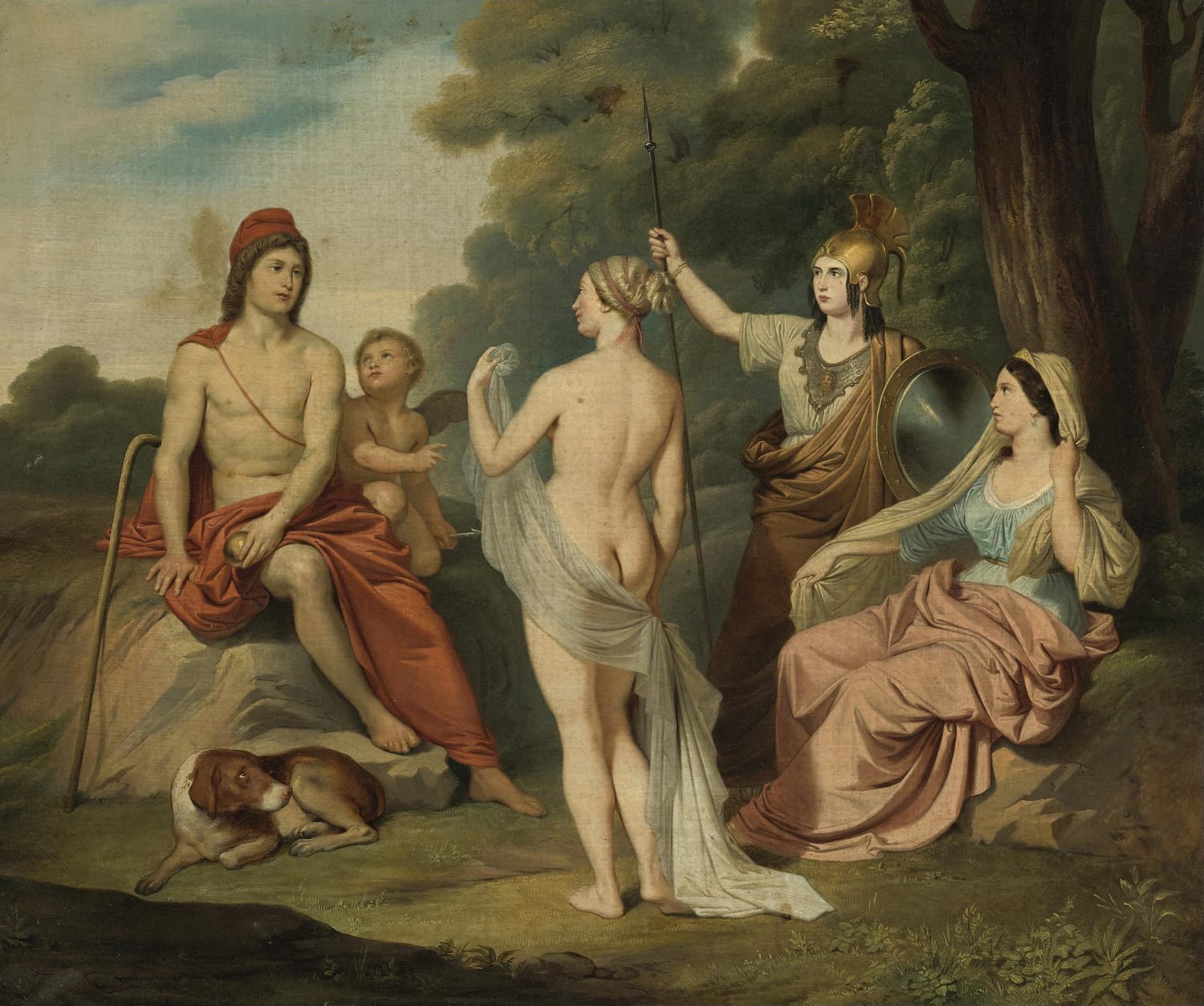
David strips away excess.
His figures are sculptural, restrained, almost political.
Paris appears more decisive, less overwhelmed, more accountable.
In the Neoclassical lens, the myth becomes a study in civic failure. A ruler making a catastrophic political miscalculation.
Here, the manipulation feels less sensual and more strategic.
The choice becomes governance.
And governance becomes downfall.

The Destruction of Troy: A Slow Burn
After Paris chooses Aphrodite, he travels to Sparta. And Helen leaves with him, whether by enchantment or consent depends on the version.
Her husband, Menelaus, calls upon every Greek king who once swore an oath to defend her marriage.
Agamemnon leads the armies.
Achilles fights.
Odysseus schemes.
Ten years later, Troy collapses beneath a wooden horse.
But the war did not begin in a battlefield.
It began one mind: Paris’

The Real Judgment
The Judgment of Paris is not about jealous goddesses.
It is about discernment.
Every day, we are offered our own golden apples:
Power without integrity.
Wisdom without humility.
Beauty without consequence.
The myth endures because it understands something timeless:
One poorly curated desire can undo an empire.
Troy was not destroyed in a single night.
It was destroyed the moment a prince confused temptation with destiny.
And that, more than the war, is the masterpiece the Greeks left us.
Judgment is never isolated.
A single choice does not remain small. It gathers momentum. It attracts reinforcement. It invites more decisions that justify the first one.
Choice becomes pattern. Pattern becomes character. Character becomes fate.
Like a snowball rolling downhill, our judgments accumulate weight with time… whether toward wisdom or toward ruin.
What feels like a private compromise today can become a public consequence tomorrow.
Paris did not see flames when he chose Aphrodite and the most beautiful woman on Earth, Helen. He saw pleasure. He saw validation. He saw what he wanted.
The fire came later.
And that is the quiet warning hidden inside the myth:
We rarely feel the destruction at the moment of decision.
We feel it at the end of the pattern.
So the real question was never which goddess was fairest.
The real question is the one we face daily:
What are we empowering with our judgment…. and what future is that choice quietly building?
Because empires do not collapse in a day.
They collapse one unexamined desire at a time.

A curated Digital Atelier.
All Rights Reserved.