
Oath of Doing no Harm: With Your Words
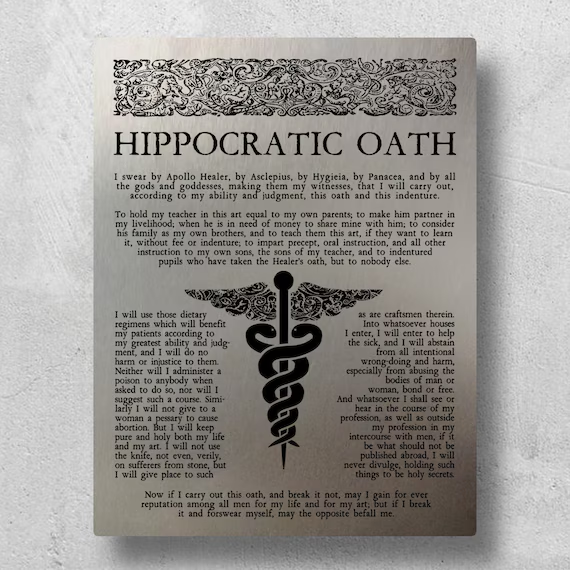
The traditional oath of “doing no harm” is attributed to Hippocrates,
often called the “Father of Medicine.”
While modern versions vary, its essence remains clear:
..."I swear to fulfill, to the best of my ability and judgment, this covenant.
I will apply, for the benefit of the sick, all measures required.
I will remember that there is art to medicine as well as science.
I will abstain from whatever is deleterious and mischievous.
Above all, I will do no harm.
I will respect the privacy of my patients.
I will remember that I do not treat a fever chart, a cancerous growth, but a sick human being..."
There is art as well as science.
Abstain from what is harmful.
Do no harm.
Knowledge is not neutral.
It becomes medicine or poison depending on the hands that hold it.
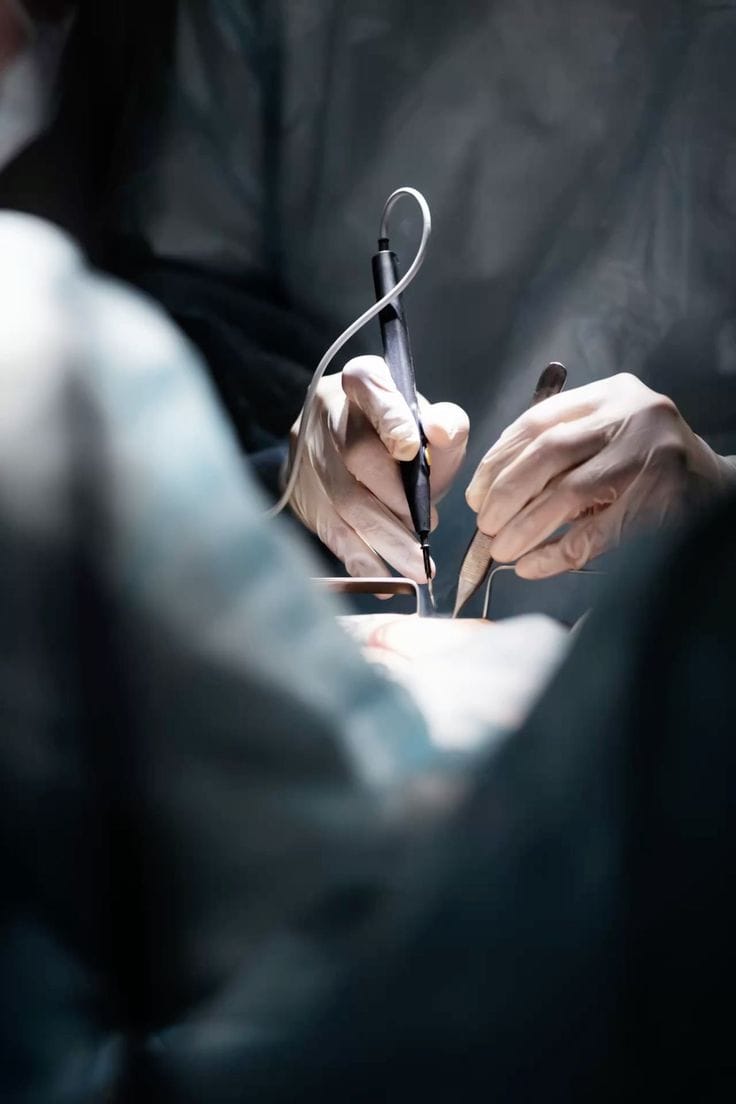
We Carry Knowledge Too
You may not hold a stethoscope, but you hold something just as sharp: language.
You know things about people.
You know secrets.
You know insecurities.
You know how to diagnose a weakness.
In a world addicted to commentary, critique, and clever sarcasm, words are used like surgical tools by people who never trained their conscience.
Information without integrity is emotional malpractice.
Self-awareness asks:
Am I using what I know to elevate or to dominate?
Am I speaking truth or performing superiority?
Because here’s the uncomfortable truth:
You can be factually correct and spiritually violent at the same time.
And no one writes headlines about that kind of harm.
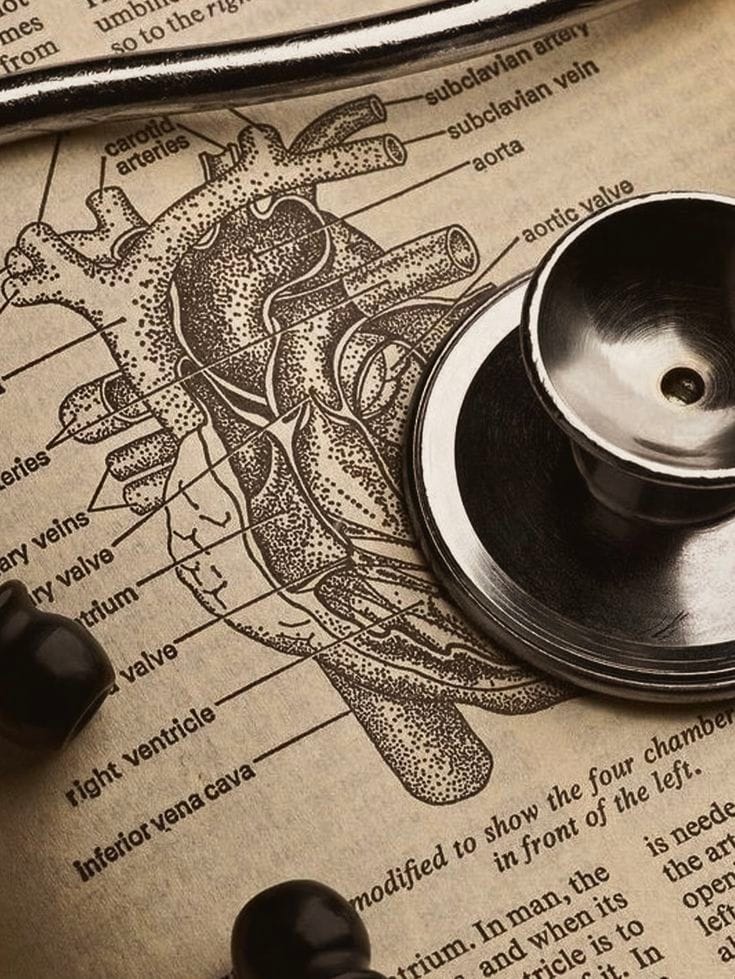
A New Feminine Oath of Doing No Harm
If medicine requires discipline, so does consciousness.
Below is a rewritten oath… not for hospitals, but for women who understand that wisdom is power, and power must be guided by grace.
Let this be our code:
I vow to hold knowledge with humility, not arrogance.
I will remember that insight is a privilege, not a weapon.
I will not use what I know about another’s wounds to deepen them.
I will abstain from words that humiliate, diminish, or manipulate, even when I am angry.
I will pause before I speak, and ask:
Is this true?
Is this necessary?
Is this kind?
I will remember that behind every mistake is a human being in process.
I will protect confidences as I would protect my own.
I will not disguise cruelty as honesty.
I will allow silence to be stronger than ego.
Above all, I will do no harm.
Not with my voice,
not with my knowledge,
not with my actions after I have learned the truth.
And if I fail, as humans do,
I will repair what I have broken.
In a World of Infinite Access
We are over-informed and under-disciplined.
Psychology, trauma theory, attachment styles, shadow work… these are sacred frameworks. Yet they are now casually thrown into arguments like glitter on a battlefield.
“You’re projecting.”
“That’s your trauma.”
“You’re insecure.”
Clinical vocabulary. Used carelessly. Cutting deeply.
Just because you understand a wound does not mean you are authorized to press on it.
Medicine requires years of training before a doctor touches a patient.
Self-awareness requires years of maturity before you diagnose a soul.
Words carry weight beyond what we see.
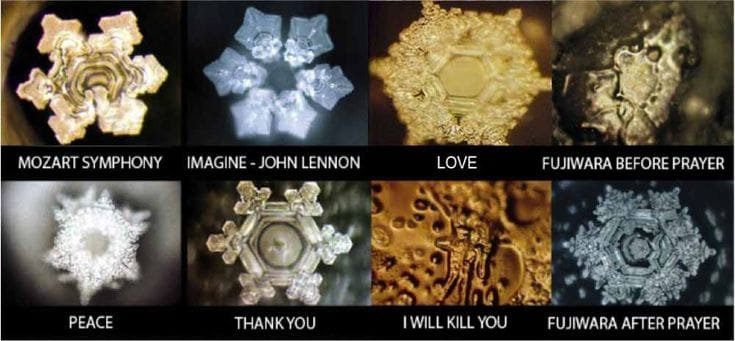
Japanese author Masaru Emoto famously photographed frozen water crystals after exposing them to different words and intentions.
“Love” and “gratitude” formed intricate, symmetrical snowflake patterns, while harsh or hateful words appeared chaotic and fragmented.
The symbolism is striking: if water (the very substance that makes up most of our bodies) responds to intention, imagine what human hearts absorb daily.
Whether metaphor or measurable phenomenon, the message remains powerful: language imprints.
Words do have measurable biological impact.
Because human nervous systems respond to language.
When someone speaks harshly to you, your body does not treat it as “just sound.”
The brain processes language in regions tied to threat detection. The amygdala activates. Cortisol can rise. Heart rate changes. Muscles tense. Your body shifts into defense.
Conversely, affirming language activates reward pathways. Dopamine and oxytocin can increase. Feelings of safety regulate the nervous system.
The prefrontal cortex, the part responsible for reasoning and emotional control, functions more effectively when we feel respected.
Words influence perception.
Perception influences biology.
Biology influences behavior.
The power of words is neurological reality.
Language shapes neural pathways.
Repeated speech patterns reinforce belief systems.
Internal dialogue rewires identity.
Public words shape culture.
Political rhetoric shifts nations.
A single sentence can alter someone’s self-concept for decades.
That is power.
Not mystical. Not fragile. Not symbolic.
Structural.
Who Do We Swear By?
History deserves clarity.
The ancient version of the oath attributed to Hippocrates began by invoking Apollo, along with other Greek deities associated with healing.
In that time, medicine and spirituality were intertwined.
To swear by a god was to bind yourself to something higher than your ego.
It wasn’t casual. It was covenant.
Contemporary medical oaths are secular or adapted to the graduate’s personal faith. Many doctors swear by God, some by their own conscience, some by humanity itself.
The mythology has been removed, and yet the ethical weight should remain.
So why did the ancients swear by Apollo?
Because they understood something timeless: Power must answer to something greater than itself.
Apollo represented both healing and plague.
Light and destruction. Cure and curse. T
hat duality mirrored reality… the same hands that heal can harm.
But here is where your message evolves.
Duality may describe the world.
It does not have to define our allegiance.
If you believe in one sovereign God… not symbolic light, not mythological balance, not cosmic neutrality, then your oath is not to dualism.
It is to Good.
Not shifting. Not conditional. Not half-shadow.
Good.
The ancient Greeks swore by the gods of their understanding, just as many people today swear by the highest authority they believe in.
Today, we choose who governs our conscience.
And if your loyalty is to the One who is wholly good, then your standard rises.
Because when you swear by Good itself, you eliminate the excuse of duality.
You don’t say, “Light and darkness coexist.”
You say, “I choose light.”
That changes the entire energy of the oath.
And we stop living in a permissive state of chaos and destruction. We align ourselves with what is good, and even when we fall short, we choose to do better, as God asks of us.

The Oath of Doing No Harm anchored in Good
If Apollo embodied both healing and destruction, your covenant rejects that split.
Your words are not allowed to wound just because you can.
Your insight is not permitted to expose just because it is accurate.
Your knowledge is not neutral. It is accountable.
To swear by God, truly, means:
I will not weaponize wisdom.
I will not justify cruelty as honesty.
I will not call harm “truth-telling” to soothe my pride.
Because the One I answer to is not divided.
When your allegiance is to absolute Good,
your speech becomes aligned with it.
Not clever.
Not cutting.
Not spiritually superior.
Aligned.
A woman rooted in God carries that enforcement within her.
So the evolution of the oath is not rebellion against history.
It is refinement.
From mythological accountability…
to divine alignment.
And that, my dear, is how “doing no harm” becomes more than restraint.
It becomes devotion.

The Real Power Move
Restraint.
Anyone can expose.
Anyone can correct.
Anyone can win an argument.
It takes evolution to protect someone’s dignity, even when you’re right.
It takes character to refuse to weaponize what you know.
And that is the kind of intelligence that builds empires instead of breaking hearts.
So before you speak,
before you post,
before you reveal…
Remember:
You are carrying medicine.
Handle it accordingly.
Because the same knowledge that can heal, can also hurt.
For what you speak can restore a soul, or fracture it.
A curated Digital Atelier.
All Rights Reserved.